




A decade of development
STA’s CEO Dave Candler on reaching a milestone in his career

This year, The Swimming Teachers’ Association’s CEO Dave Candler celebrates ten years in the role. Move Professional caught up with Dave to discuss his lifelong passion for all things aquatic. From the roles and the people that supported his growth to the challenges that continue to drive the STA towards developing a more professionalised sector, Dave shares his story.
Firstly, please tell us a little bit more about you, and how you got into the world of swimming?
I was a swimmer when I was young. From the age of about five I was swimming at our local leisure centre and having lessons. I wasn’t great. I was okay. But I swam a lot. I swam six days a week, I swam in the local swimming club, I swam in swim squads and I swam in lifesaving clubs and competitions. As soon as I was 16, it naturally progressed into doing the lifeguard qualification and getting a job at the local leisure centre.
Before we get on to how your career progressed, how big of an influence were your parents in your love of swimming?
Weirdly, neither of my parents were big swimmers. They weren’t really into it. But one thing that they always drove into me and my brother was just to work hard, be committed and do your best.
So from starting as a lifeguard, how did you career pathway develop from there?
I spent a long time doing all the different jobs you can imagine around the leisure centre, from the cleaning and running kids parties to badminton coaching and roller skating sessions. It was a really good way to get into the whole sector.
I was actually initially doing it for some money to support me through school and then college. I was planning on being a vet. I was doing a degree in molecular sciences and realised that that was very boring, so I jumped on to do animal science. But I was always working at the leisure centre. It was a great social life, it was a great place to be, and obviously, as you get older, you want more money to go out and do various things. And then the swimming teaching option came up and I absolutely loved it.
From that, I then became a tutor and started training other swimming teachers, then a senior tutor. I was doing duty manager work, I did my gym instructor course, I basically threw myself into whatever course I was offered.
Later, I became the swim school coordinator for a big swim school. We had about 9,000 kids a week on the lessons, so it was huge at the time. I started at the pool in 1991 and I worked there for 25 years. I also ran Arundel Lido. So, every summer I was managing that.
At one stage we had around 90 teachers and I was responsible for the lifeguard training, the pool plant training, first aid training and swimming training. So, that’s where I started tutoring and I ended up running a training business called Inspire Leisure alongside my other job. So every weekend, evenings, holidays, I was running courses.
So you then became a trustee with the STA. How did that relationship come about?
I became known because I’m quite outspoken about the sector and what I think needs to change. I always have been because I’ve been on the other end of it. I was the one that was doing the courses, employing the teachers. Being critical is sometimes a very positive thing.
So, the opportunity came up and I became the youngest ever trustee at the STA. I did that for a few years, learned an awful lot, and then they asked me if I’d become the president.
Then in 2016, an opportunity came up for CEO, and I was lucky enough to get the job.
Do you have any other roles outside of the STA currently?
I don’t tutor anymore, but I still coach swimming at my local swimming club. I missed it so much. I actually went back to it last year. I like to stay in touch with the sector and what’s going on. My wife also runs a swim school of her own. I think it’s vital to have a good understanding of the market.
What would you say are probably the STA’s biggest challenges that you’re preparing for in the next few years?
I think we’re all aware of many of the main challenges – energy costs. That’s causing a problem around the number of pools that are closing down.
Staff numbers are a huge concern and keeping people in the sector. That’s something that really niggles me and has done for a long time. We’ve got 21,000 swimming teacher members – more than anyone else in the UK. And one of the things that they constantly talk about all the time, even now, is that they don’t feel valued as employees.
And that’s something you’re really passionate about, isn’t it?
It’s something that I’ve talked a lot about at conferences and in articles. We want to professionalise the sector, which is something that CIMSPA is also pushing for.
We all know it’s cheaper to keep existing staff and train them than it is to recruit new people and onboard them. And I don’t understand why this sector, in comparison to most others, operates with loads of zero hours and casual staff. They need guaranteed income to pay their mortgage, to pay their bills, to buy their food, to feed and clothe their kids. They’re real people. They deserve a contract. Even a shorter term contract, so at least it’s guaranteed and it’s known.
I don’t understand the resistance to it. I think some of it is old school mentality of this is how it’s always been, this is how we’ve always done it. If people can reward and look after their staff, they’ll see the benefits tenfold. They really will.
People buy into people. That’s what they do. If you’ve got great staff and good teachers, people will come to you because the word will get round. You don’t need to advertise.
So, how important is continual learning to your staff and members?
It’s absolutely vital. I think this is something that I’ve seen a real shift in over the years. I was very lucky with this. I used to work for a district council, which then moved into being Inspire Leisure, and they were both very good at ensuring that we got a lot of extra training and continuing professional development (CPD).
We have launched our new qualification this year and everybody who completes that course gets a block of CPD afterwards.
So the initial course is just the beginning of the learning journey. I worry about the number of organisations popping up, training people with unregulated courses that don’t meet professional standards. It’s a professional job. It’s a licence to practice. You’ve got people’s lives in your hands and I think that’s where something like a workforce register would change the game.
Are you seeing any trends or issues in terms of recruitment or skills gaps in the sector?
Recruitment, yes. Skills gaps, no. I think skills gaps have largely been addressed. Both STA and Swim England have launched new qualifications this year, aligned to the latest professional standards.
Historically, the swimming teaching qualification landscape could be quite confusing, with different qualification titles and pathways available across the sector. At STA, we previously offered both Award and Certificate swimming teacher qualifications, but feedback from employers, learners and the updated CIMSPA Professional Standard highlighted the need for a clearer and more consistent route into the profession.
As a result, we introduced a single Level 2 Swimming Teacher Qualification. We had concerns, obviously, about whether the sector would be ready for such a radical change, but as the updated professional standard developed, it became increasingly clear that a simplified pathway was the most sensible route forward. It provides a clearer starting point for new teachers and a more straightforward benchmark for employers.
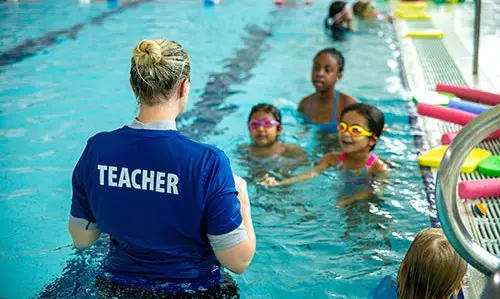
There is no shortage of demand for swimming teachers in this country. Everybody wants swimming teachers. The biggest thing now is who gets them, because there’s a lot of private swim schools, teaching in schools, pop-up pools, hotel pools, holiday parks. We’ve even got members who are building their own swimming pools or hiring private pools in houses. Those numbers tend to get missed off when you talk at government level because they just talk about national operators.
Those private swimming schools pay more, so they tend to get the pick of the swimming teachers. And then the national operators quite often pay a bit less, so what they tend to do is set up an approved training centre and train their own, which is a brilliant and sensible model. Train your own swimming teachers when you need them. That’s what I did and I never once advertised for a swimming teacher. I ran courses and then I hand-picked the ones I wanted off it and went and offered them a job at the end. It was basically a week-long interview.
Do you have any thoughts about how you maintain a healthy work-life balance?
Because I don’t feel like it’s a job, because I genuinely love it, there’s nothing else I’d rather do than this. I will put in whatever hours I need to do. During the COVID period, I was doing upwards of 120 hours a week.
But in terms of work life balance, I live and breathe it. I am quite good now at making sure that I take time to go for a swim every day. I don’t get particularly stressed with work. I get frustrated with things but then I go for a swim and it’s all gone.
What would be the best piece of advice that you would give to someone stepping into the industry or a similar senior role?
Being down to earth and grounded is vital, but absolutely not being scared to challenge the norms. Is it the way that’s best for the customers? Is it the way that’s best for the staff? If it isn’t, let’s change it.
Have there been any individuals that have helped shaped your management style or philosophy?
My previous manager at the leisure centre was the person who saw something in me that pointed me in the direction of the management qualifications. He really pushed me to do it. I hadn’t seen him for years but I saw him recently and he literally just said ‘I’m so proud of you. I always knew you were going to do well’. I think that there’s a natural drive within me. I love the sector, I love what we do.
What drove you to towards achieving chartered status?
I wanted to do it for a long time. I was always thinking am I ready to do it? I thought to be a chartered professional in that capacity, you’d have to have done the job for 40 years and be one of the older guard. And then I thought it’s coming up for 10 years of me doing this job, we’re doing well, our membership’s more than doubled and we’ve done lots that I’m really proud of, including the Stand Up for Swimming campaign, and I just thought, now’s the time. I’m going to have a go.
It wasn’t about acknowledgement. It was more about continual learning and have I done a good enough job that I’m deemed worthy of getting this?
In a busy job, you don’t often sit back and look at the achievements and look at what you’ve done. I was so proud of it. It’s something that I’ve always wanted to achieve. I was genuinely buzzing when I found out I’d passed.