



Mind-first matters
Mental Health PT Dan Hancock explains how his holistic approach to training supports clients with mental health challenges
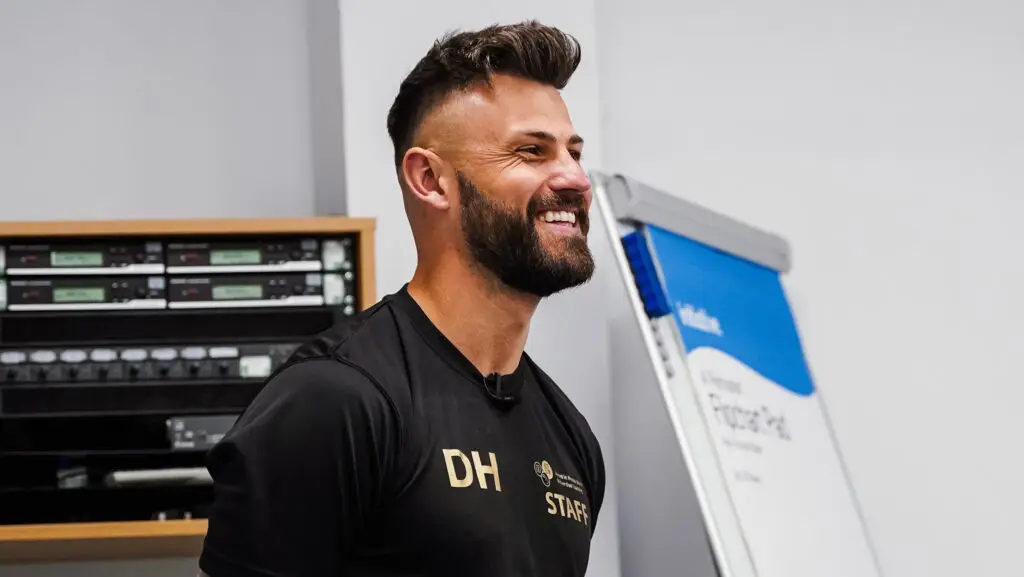
Approximately 5.6 million people in the UK who are of working age and employed have been a diagnosed with a mental health condition. In a recent survey, 72% of those asked said exercise helped them to stay at work. We spoke to Dan Hancock, CIMSPA Training Provider Partner and creator of the 3-star ‘Enhancing’ mental health and exercise coaching course, to get his thoughts on what sport and physical activity professionals can do to support those with mental health conditions – and all clients – to take a mind-first approach to exercise.
Dan and the MHEC Academy
Dan is the founder of the MHEC Academy, offering mental health and exercise coaching. He is known online as the Mental Health PT for creating the award in mental health and exercise coaching, which is a mental health certification for fitness professionals and sports coaches.
The award in mental health and exercise coaching equips fitness professionals with the skills to identify if individuals they’re working with are struggling mentally, carry out earlier exercise-based interventions and use exercise as a tool to promote positive mental health.
Although their work revolves around supporting individuals with their mental health, MHEC Academy encourages everyone to improve their minds through exercise. This mind-first approach is central to the organisation’s ethos.
How did you become a personal trainer?
“I always loved sport and physical activity from a young age. I played football when I was younger and I didn’t quite realise that sport was probably a way for me to regulate my undiagnosed ADHD. Sport was such a physical release because when you’re running about outdoors, you’re not just freeing the body, you’re freeing the mind.
“Unfortunately, when I was in my mid-teens, I was the victim of a serious assault. I stopped playing football and my mental health started to deteriorate. I started to go down the wrong path, abusing alcohol, getting into trouble with the police and almost going to prison. At one stage in my life, I woke up and thought ‘there’s got to be so much more to life than this. How can I get myself back on track?’ I thought of the things that I loved when I was a youth and one of them was sports. I thought, ‘you know what, I’m going to go join the gym and take up exercise’. I immediately fell in love with the gym, and I loved how it made me feel. I saw exercise as a gift and I thought, ‘how can I share this gift with other people?’ So I trained to become a personal trainer around 15 years ago.”
Was it your lived experience that made you want to specialise in with working with people who had mental health struggles?
“It was a mixture. The first reason was because I knew what it was like to have so much disorganisation, discomfort and dissatisfaction in my life. Exercise was the fundamental vehicle that pulled me from that place. It didn’t just make changes within my brain and to my body, it taught me incredible life skills like discipline, determination and self-awareness that I could use and apply to other areas of my life.
“The second reason was that when I was training as a personal trainer, I’ll never forget the day that a client came to me with the announcement that she dropped 10 stone and she’d never been more unhappy. I thought, ‘what’s going on here? There’s a missing link. People are always talking about exercising to drop weight or to look a certain way. I’m helping people do that, but people are still dissatisfied.’ I started to ask more questions and identify the real reasons why people were coming to me.
“Some of it was mental health conditions – they were depressed or struggling with anxiety. The majority of people, though – almost every single person that came to me – were looking to improve their mental health in some capacity. As soon as I started to ask these questions, it became more apparent. This was the real reason why people are coming to me. I’d better start coaching them in line with those goals as opposed to just appearance-based goals.”
How do mental health struggles affect clients’ approach to exercise?
“What we’ve identified throughout our research is that appearance-based goals are the main motivator for people to reach out to a fitness coach. People think they’ll achieve happiness once they achieve a certain body shape, but their real goal is to be happy, confident and experience love.
“All our research shows that if you aren’t driven by the correct goal, it’s going to massively decrease the chances of you being consistent with your exercise sessions. You’re not going to be able to build a habit and you’re more likely to skip sessions. Therefore, you’re going to be more likely to experience guilt, and that has been shown to further lead to disordered relationships with exercise, your body image and nutrition. What we are then identifying is the main reason why people aren’t achieving their exercise goals is because they’re setting the wrong goal.
“One of the things that we need to do as coaches is to be able to understand the real reasons why people are coming to exercise, the real goals they have set for themselves. That will also allow us to be able to see the obstacles and barriers that are in people’s way.”
How would you adapt an exercise programme to account for fluctuating symptoms of poor mental health?
“Across individuals who are struggling mentally, their heightened levels of anxiety and low mood lead to less energy. The fundamental thing that we need to do to address motivation and therefore consistency is make exercise fun. Exercise is viewed as a punishment, and we need to view it as something else. Exercise is not just there to burn calories, it’s something to build character.
“Exercise is something that empowers us, that makes us feel more confident, that develops life skills such as resilience and self-worth that can be applied to everyday life.
“The biggest thing that you need to do with individuals who are struggling mentally, but also with all populations, is find a form of exercise that they absolutely love, that makes them feel empowered, that allows them to grow in confidence with every single session.
“That’s going to reduce or remove all the barriers to exercise, like feeling unfit, feeling foolish, feeling as if they’re incapable or feeling like the gym isn’t for them. Building those skills is allowing them to make exercise a habit. Then, once habituation takes place, that is what leads to consistency. Consistency leads to momentum. All of a sudden, you’ve got individuals that love exercise and they love the gym. So yes, changing the intensity and frequency of exercises for individuals who are potentially struggling mentally obviously has to be a consideration, but the work starts before they enter the gym. It’s about changing the perspective of what exercise is and what it’s for.”
When you’ve tapped into what clients love, in what ways are you measuring success?
“We measure things on a sliding scale. When an individual first comes to exercise, we will measure their happiness, confidence, self-worth and their body appreciation. That has nothing to do with their body image – it’s about the way that their body moves and performs and their relationship with food. We’ve now created a list of up to 48 different exercise by-products that we can measure rather than using conventional and traditional metrics, which are weight on the scales or, for more performance-based gym personal bests, weight increases on the bar.
“Week on week, we’re able to measure the percentage point increases. So, over that period of 90 days for example, we have data to say their happiness has improved by 60%, their confidence has improved by 80% and their relationship with food has improved by 70 or 80%. As a result, we’re making exercise more inclusive and more accessible.”
Do you work with any other healthcare professionals to support your clients’ mental health goals?
“Personal trainers are in the perfect position to have earlier interventions. Because a lot of people are choosing a more holistic approach to their mental health, some people may be choosing a personal trainer over a doctor or therapist. With that in mind, it is vitally important that coaches understand their boundaries and limitations.
“There are personal trainers that are doing way more than they should be doing – overstepping the mark – and there are personal trainers who aren’t doing anywhere near enough.
“What we do is give practitioners the skills to be able to recognise, identify and support individuals, but we also we teach them about how to create a fantastic referral process so that they’re bridging the gap between exercise and mental health services. One of the core things that we need to understand is limitations, boundaries and then how we can create referral networks with doctors and with therapists.”
How does neurodiversity intersect with mental health when it comes to engaging in exercise?
“I’m going to answer this with a very short story. We had an individual reach out to us a couple of years ago because their daughter, who was 9 at the time, was having issues in the classroom. She couldn’t concentrate and teachers felt she couldn’t sit still and wasn’t paying attention. She was struggling with Tourette syndrome and with the additional challenges that that brings, such as anxiety, low moods, stress and really low energy. Rather than just coaching the daughter, we extended our support to her mum so that a family-based intervention could take place.
“Over the course of the coming year, mum and daughter took part in exercise using our MHEC methods. The daughter absolutely loved exercise and started excelling in school – her grades went up and her Tourette symptoms improved. The mum then came to train with us and became a personal trainer and a mental health and exercise coach. She now helps other parents in her area with children who are struggling with neurodiversity. Overall, the quality of life for the family improved through exercise.
“Exercise is one of the best tools for children and adults to be able to express themselves, but none more so than neurodiverse individuals who are struggling with the demands of life and need an outlet. Physical symptoms and mental symptoms should and absolutely need to be managed through exercise.”
If you could give one piece of actionable advice to other physical activity professionals or organisation leaders, what would it be and why?
“The fitness space is moving in a more holistic direction. Gone are the days of just using exercise to be able to look a certain way or, from a sports standpoint, as a performance-based thing. More people are going to be taking up exercise to be able to improve their minds and quality of life. We need to learn how to be more accessible so that these individuals can take up exercise and be able to give them the greatest quality experience.
“There are so many barriers to exercise. We need to remove the barriers. We need to make exercise more inclusive. We need to focus on a mind-first approach so that we can get people a real, long-term, sustainable result through exercise. That’s what’s going to allow us to make a real change to the country, because the more people that we’ve got sticking with exercise long term, the fewer health implications we’re going to have and the less money that we’re going to lose to staff sickness and stress.
“Then, in return, we’ll have greater productivity, greater creativity and greater connection as a community working on a mutual goal. The future of fitness is holistic, and as fitness professionals, we need to get on board with that now.”
Find out more about Dan and the MHEC academy at www.mymhec.com or via his social media channels @mentalhealthpt